
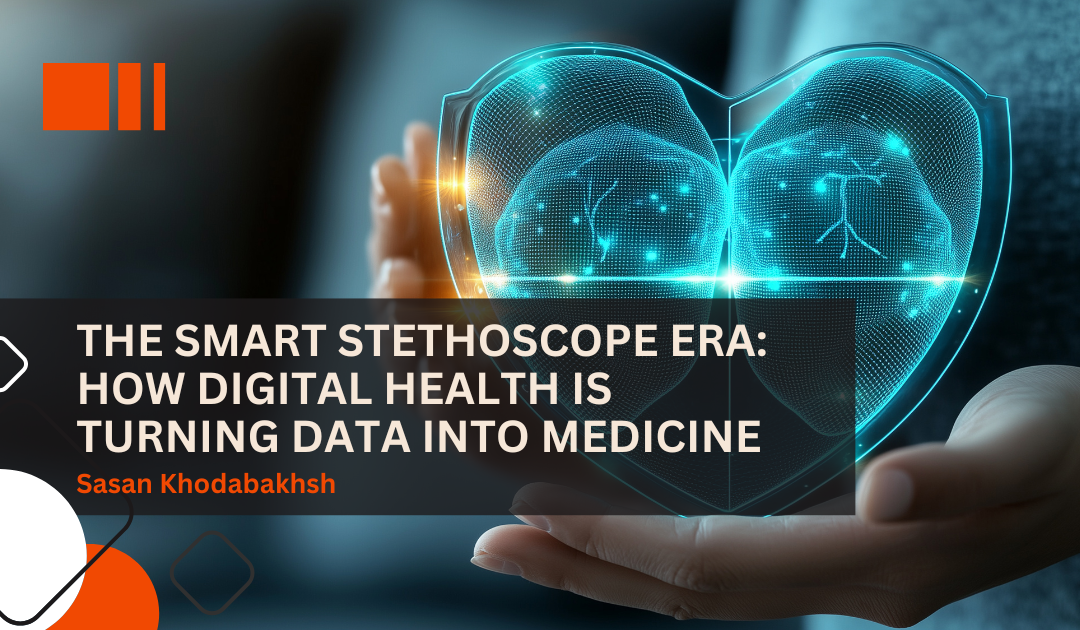
The stethoscope once symbolized the pinnacle of medical care — a simple tool, yet a powerful bridge between doctor and patient. But today, that bridge is being rebuilt — with sensors, algorithms, and data streams replacing rubber tubing and earpieces.
Welcome to the Smart Stethoscope Era, where healthcare doesn’t just listen to the body; it understands it in real time. From wearable devices decoding heart rhythms to AI models predicting disease before it strikes, medicine is undergoing a digital renaissance — one that blurs the line between science and software.
When Data Becomes the New Diagnosis
In traditional medicine, diagnosis begins with observation — what a patient says and what a doctor sees. But digital health flips the equation: your body speaks first, through data.
Your smartwatch, sleep tracker, and glucose sensor are quietly gathering millions of data points daily — heartbeats, steps, oxygen levels, even mood indicators. This continuous “digital footprint of health” enables doctors to see not just a snapshot during an appointment, but the movie reel of your body’s rhythms.
AI-driven analytics now interpret these signals to detect anomalies early — from silent heart arrhythmias to stress patterns that precede burnout. It’s medicine that doesn’t wait for you to fall ill; it intervenes before illness begins.
The Doctor Will See Your Data Now
Telehealth has matured from video calls to fully integrated virtual ecosystems. Picture this: your wearable detects abnormal blood pressure trends, automatically alerts your digital health provider, and schedules a virtual consult — all before symptoms even appear.
Meanwhile, smart home devices can now monitor medication adherence, track sleep, and even assess respiratory health through voice patterns. For chronic conditions, this means personalized care plans that adapt in real-time — no hospital visit required.
This “hospital without walls” model is quietly redefining accessibility, bringing advanced healthcare into living rooms, workplaces, and remote villages.
DNA Meets AI: The Rise of Predictive Precision Medicine
Perhaps the most futuristic frontier lies where genomics meets artificial intelligence. By combining DNA sequencing with big data, doctors can now map an individual’s disease risk profile with extraordinary precision.
Imagine a future where your genetic data, daily habits, and environmental exposure merge to create a digital twin of your body — a virtual replica that predicts how you’ll respond to medication, stress, or even diet.
This level of personalization could make the trial-and-error phase of medicine a thing of the past.
Balancing Bytes and Bedside Manner
But here’s the paradox: as medicine becomes more digital, the need for empathy becomes more vital. Algorithms can analyze, but only humans can understand. The future of healthcare will hinge on blending technological intelligence with emotional intelligence.
The best doctors of tomorrow won’t just interpret lab results — they’ll interpret data stories.
A Glimpse Ahead
In the Smart Stethoscope Era, every heartbeat, breath, and byte tells a story — and together, they’re rewriting the language of medicine. As healthcare transforms from reactive to predictive, from fragmented to connected, the future promises something both profoundly human and technologically extraordinary:
A world where data doesn’t just measure life — it helps us live it better.